
AI conversational agents are already changing mental healthcare. The real question is no longer whether clinicians should engage with AI, but whether they will help shape its use—or leave those decisions entirely to technology companies.
AI can support disclosure, education, and communication, but it cannot replace clinical judgment, ethical responsibility, or the human relationship. Clinicians must become the guardrails.
Why clinicians need this now
The emerging expert consensus emphasizes transparency, clinical oversight, privacy, and reliable escalation procedures. But knowing these principles is not the same as knowing how to apply them.
How should clinicians evaluate an AI tool? Where does therapeutic storytelling fit? How can AI, VR, and digital media support reflection without pretending to provide psychotherapy? What protects clients when technology gets it wrong?
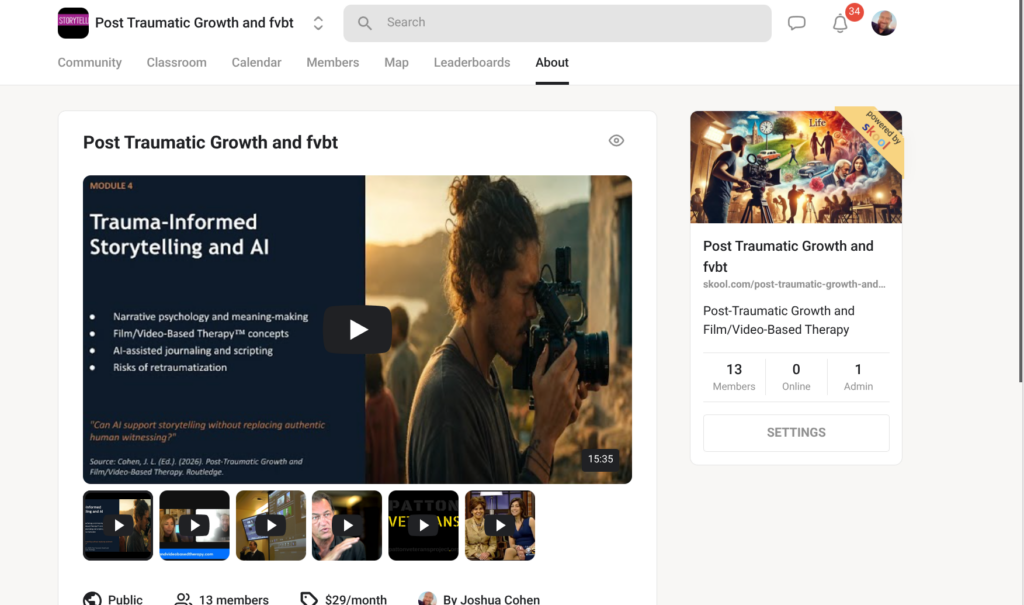
These are the questions we examine inside the Post-Traumatic Growth & FVBT® Skool community.
What members receive
The community connects research on trauma, nervous-system regulation, post-traumatic growth, AI, VR, and FILM/VIDEO-BASED THERAPY® within one structured learning environment.
Members explore:
- How clinicians can remain meaningfully “in the loop”
- Ethical guardrails for conversational AI
- The relationship between psychological safety and disclosure
- How storytelling can create distance from overwhelming experiences
- Applications of AI and VR in therapeutic and educational settings
- FILM/VIDEO-BASED THERAPY® principles and case-based discussions
- New research, professional conversations, and developing applications
This material draws from Dr. Joshua L. Cohen’s Routledge trilogy and decades of work in media psychology, digital storytelling, trauma, and therapeutic filmmaking.
Who should join
The community is designed for:
- Clinicians and mental-health professionals
- Filmmakers and digital storytellers
- Researchers, educators, and graduate students
- Veterans’ advocates and peer-support professionals
- Developers working with AI, VR, or mental-health technology
Call to action
AI can process language, but people provide meaning, accountability, and human connection.
Join the Post-Traumatic Growth & FVBT® Skool community to learn how clinicians and storytellers can help shape the ethical future of AI, VR, and therapeutic media.
Membership is $29 per month.

{“@type”:”BlogPosting”,”image”:”https://cdn.marblism.com/w6AI_G939qB.webp”,”author”:{“url”:”https://yourdigitalstorytellingproject.com/about-film-video-based-therapy”,”name”:”Dr. Joshua L. Cohen”,”@type”:”Person”},”@context”:”https://schema.org”,”headline”:”AI Won’t Replace Clinicians—but Clinicians Who Understand AI Will Lead the Future”,”keywords”:”AI in mental health, clinician leadership, Film/Video-Based Therapy, post-traumatic growth, ethical AI, therapeutic media”,”publisher”:{“logo”:{“url”:”https://cdn.marblism.com/BdoyCIKdn5-.webp”,”@type”:”ImageObject”},”name”:”Your Digital Storytelling Project 2 LLC”,”@type”:”Organization”},”mainEntity”:[{“name”:”Will AI replace clinicians in mental healthcare?”,”@type”:”Question”,”acceptedAnswer”:{“text”:”No, AI cannot replace clinical judgment, ethical responsibility, or the human relationship. However, clinicians who understand and use AI will shape the future of the industry.”,”@type”:”Answer”}},{“name”:”How can clinicians lead in the age of AI?”,”@type”:”Question”,”acceptedAnswer”:{“text”:”Clinicians must act as the guardrails for AI tools, ensuring transparency, privacy, clinical oversight, and ethical storytelling in therapeutic settings.”,”@type”:”Answer”}}],”description”:”Explore the ethical future of AI in mental healthcare. Learn why clinician leadership is essential for the responsible integration of AI, VR, and therapeutic media.”,”datePublished”:”2026-07-19″,”articleSection”:”Media Psychology & Healthcare Technology”,”mainEntityOfPage”:{“@id”:”https://yourdigitalstorytellingproject.com/blog-2″,”@type”:”WebPage”}}