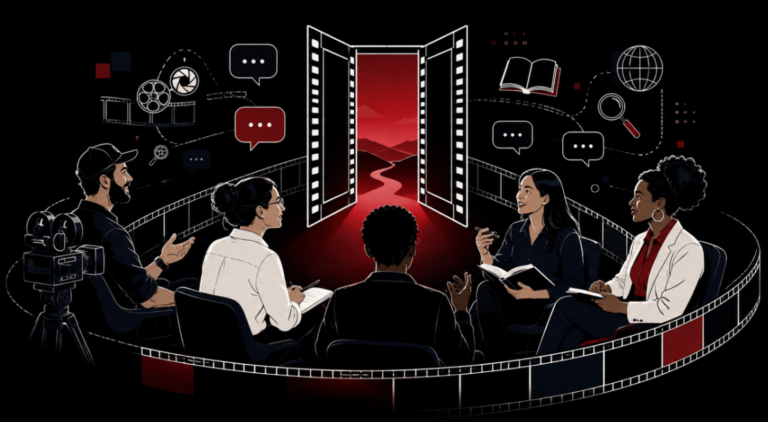
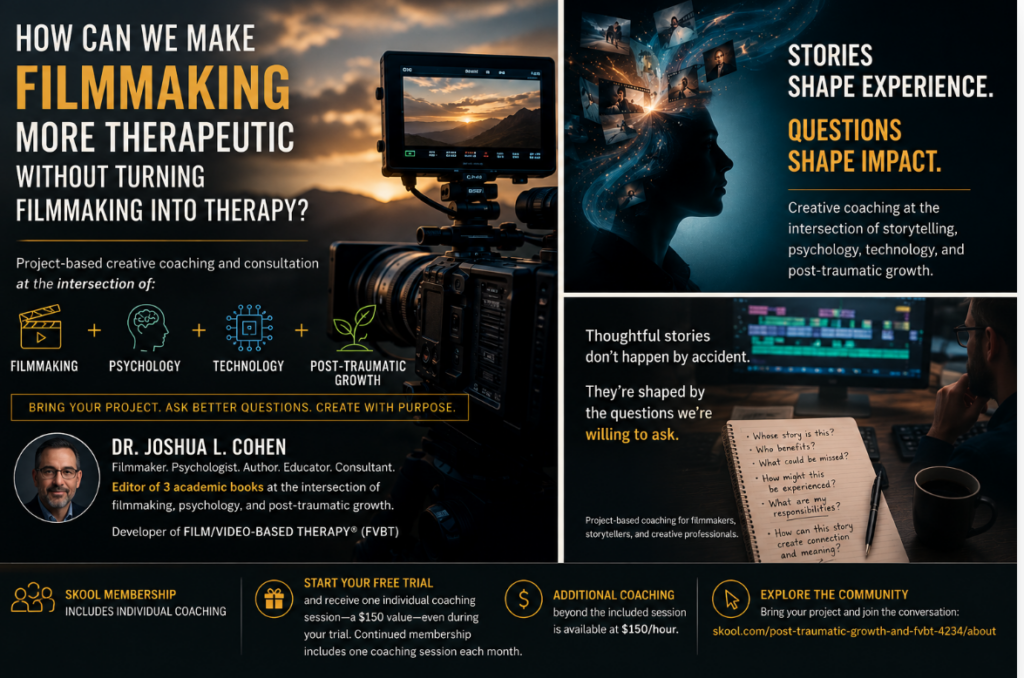
This article describes project-based creative coaching and consultation at the intersection of filmmaking, storytelling, psychology, technology, and post-traumatic growth. It is for filmmakers, documentary makers, screenwriters, digital storytellers, educators, artists, creative producers, and other appropriate creative professionals working on emotionally meaningful or psychologically informed projects.
Dr. Joshua L. Cohen helps you bring the project you are actually making and ask better questions about story, audience experience, representation, consent, technology, ethics, and the psychological dimensions of the creative process.
If you have asked, How can we make filmmaking more therapeutic without turning filmmaking into therapy? this is the practical and intellectual space the article is addressing.
POST-TRAUMATIC GROWTH THROUGH TECHNOLOGY is the central concept connecting the piece. It is the bridge among:
FILMMAKING + STORYTELLING + PSYCHOLOGY + TECHNOLOGY + POST-TRAUMATIC GROWTH
This is an area of inquiry and creative practice exploring how filmmaking, digital storytelling, VR, AI, editing, cameras, and other technologies may support reflection, meaning-making, agency, connection, and exploration after adversity. It is not a product claim, not a clinical method by itself, and not a guaranteed outcome. Technology does not cause post-traumatic growth, trauma does not inevitably lead to growth, and no outcome is guaranteed.
We can make filmmaking more therapeutic without turning filmmaking into therapy.
The practical question is how creative media and emerging tools can be used more thoughtfully while respecting consent, context, safety, and human dignity. Dr. Cohen’s coaching applies POST-TRAUMATIC GROWTH THROUGH TECHNOLOGY to the projects people are actually making.
This is not a promise that technology produces healing. It is a framework for asking better questions about how creative work and emerging tools shape reflection, meaning, agency, relationships, and representation after adversity.
The medium itself is not the therapist.
Skool Membership Includes Individual Coaching
Start your free trial and receive one individual coaching session—a $150 value—even during your trial. Continued membership includes one individual coaching session each month.
Additional individual coaching beyond the included session is available at $150/hour.
This is a low-risk way to explore the Post-Traumatic Growth & FVBT community, bring a real project into the conversation, and receive the included coaching benefit during your trial.
Dr. Joshua L. Cohen helps filmmakers and other appropriate creative professionals make their creative process and resulting work more psychologically thoughtful, responsible, meaningful, and potentially therapeutic without turning filmmakers into therapists.
What “therapeutic” can mean in creative work
In everyday language, people often use the word therapeutic to describe an activity that supports reflection, expression, connection, or a sense of relief. Filmmaking may have qualities that encourage those experiences when the work is designed thoughtfully.
What does a story invite someone to feel, remember, or reconsider? Whose meaning is being shaped through the creative process? What remains outside the filmmaker’s control once the work meets real people in real contexts?
That answer depends on the project.
These possibilities should not be treated as guaranteed outcomes. Post-traumatic growth remains an area of exploration, not a result that can be promised or demanded. Trauma is not beneficial in itself, and no one should be pressured to find a silver lining in suffering.
That distinction is central to responsible storytelling.
The difference between filmmaking and therapy
Psychotherapy is a clinical service provided by a qualified mental-health professional within an appropriate professional and legal framework. Creative coaching and filmmaking consultation are different.
In a coaching or consultation relationship, Dr. Joshua L. Cohen helps creative professionals examine their projects, clarify their goals, and think through the psychological, technological, and ethical dimensions of storytelling. The focus remains on the project and creative process through creative coaching and consultation, not psychotherapy.
A filmmaker may create a documentary that helps audiences reflect on grief. An educator may lead a digital-storytelling project that supports connection among participants. An artist may use virtual reality to explore memory, embodiment, or identity. A writer may use an AI-assisted workflow and need to think through authorship, privacy, emotional tone, and psychological impact. Where does psychologically thoughtful filmmaking end and clinical responsibility begin? Who has control over the story—and when might that control change?
These are questions for project-based coaching, not a generic formula.
A media-psychology perspective on filmmaking
Dr. Joshua L. Cohen brings together experience in film, psychology, education, media analysis, and storytelling. He is a media psychologist, author, educator, and filmmaker, and the originator of the named FILM/VIDEO-BASED THERAPY® framework.
His background includes academic and professional work examining the relationship between film, psychology, technology, and human experience. His published work includes Video and Filmmaking as Psychotherapy: Research and Practice and Post-Traumatic Growth and Film/Video-Based Therapy. His current work also connects filmmaking with post-traumatic growth and emerging media.
For creative professionals, this background creates a useful bridge. You do not need to approach filmmaking as a clinical intervention in order to ask more psychologically informed creative questions:
- What emotional experience might this story invite?
- How might participants experience the production process?
- What changes when AI recreates a voice, face, memory, or experience belonging to a real person?
These are only starting points. Coaching explores a broader set of project-specific creative, psychological, technological, and ethical questions—questions that often reveal possibilities or blind spots a filmmaker may not see alone.
Post-Traumatic Growth Through Technology
POST-TRAUMATIC GROWTH THROUGH TECHNOLOGY is the larger intellectual and creative concept linking Dr. Cohen’s work across filmmaking, storytelling, psychology, and emerging media.
For filmmakers and other creative professionals, it raises questions about identity, meaning, agency, representation, technology, and responsibility after adversity. What happens when an immersive experience produces a much stronger emotional reaction than its creator expected? What changes when AI recreates a voice, face, memory, or experience belonging to a real person? What might an audience experience that the filmmaker never intended?
Your answers will depend on the story you’re telling, the people involved, the technology you’re using, and the context in which the work will be experienced. That’s where project-based coaching becomes useful.
Post-traumatic growth does not mean trauma is beneficial. It does not mean people must find a positive lesson in suffering. Growth is not guaranteed, and it should never be imposed on a participant’s story. The value of POST-TRAUMATIC GROWTH THROUGH TECHNOLOGY is in helping creative professionals think more carefully about how storytelling and technology shape reflection and meaning after adversity.
What coaching can help you do with a real project through Post-Traumatic Growth Through Technology
Individual coaching with Dr. Cohen is a practical application of POST-TRAUMATIC GROWTH THROUGH TECHNOLOGY. It is designed for filmmakers and other appropriate creative professionals who want to think more deeply, responsibly, and creatively about a project they are already making.
You can bring an actual:
- Film
- Documentary
- Screenplay
- Short film
- Digital-storytelling project
- VR or immersive experience
- AI-assisted creative project
- Educational or advocacy media project
- Other appropriate storytelling project
This is the core proposition: Bring your project. Ask better questions. Create with purpose.
Coaching can help you examine story structure, audience experience, psychologically informed creative choices, representation, consent, trauma-related material, participant and collaborator experience, cameras, editing, VR, AI, emerging technology, ethics, and when collaboration with a qualified mental-health professional would be appropriate. This public article is an introduction—the beginning of the conversation, not a complete project analysis. The Skool community provides deeper educational material, discussions, examples, resources, and frameworks. Individual coaching applies the approach directly to the filmmaker’s actual project and circumstances.
Develop stories that make room for reflection
What might your story invite an audience or participant to consider about meaning, identity, connection, or change? How might an editing decision change the meaning of someone’s experience? That answer depends on the project.
Make the creative process more psychologically informed
Filmmaking affects more than the finished product. How are power, trust, representation, authorship, and control showing up in the process itself? What might you be overlooking in the project you’re making right now? Who has control over the story—and when might that control change?
Work more responsibly with trauma-related material
Personal and trauma-related stories require care. What happens when someone agrees to be filmed but feels differently after seeing the edit? How are representation, participant agency, privacy, production practices, and distribution shaping the work? When does a creative experience that feels therapeutic begin crossing into territory that requires a mental-health professional?
Those questions are rarely answered by a universal checklist; they depend on the project, the people involved, and the context in which the work will be made and shared. The Post-Traumatic Growth & FVBT community on Skool and individual coaching explore them in greater depth through education, discussion, resources, and project-specific guidance.
Use technology thoughtfully
Technology can expand creative possibility, but it can also change exposure, memory, privacy, authorship, and emotional intensity. What changes when AI recreates a voice, face, memory, or experience belonging to a real person? What happens when an immersive experience produces a much stronger emotional reaction than its creator expected? This is one of the questions we can examine through project-based coaching.
Connect storytelling craft with POST-TRAUMATIC GROWTH THROUGH TECHNOLOGY
Some projects are explicitly about trauma, recovery, identity, grief, disability, memory, resilience, or adaptation. Others are not, but still raise questions about human change, meaning, and representation. How does your specific project connect to POST-TRAUMATIC GROWTH THROUGH TECHNOLOGY? What does it open up, and what might it unintentionally distort?
Dr. Cohen’s discussion of ethics and AI offers additional context for thinking about the human responsibilities that accompany technological creativity.

Boundaries and safeguards
One of the most important creative skills is recognizing the limits of your role.
Film and video may become meaningful tools within an appropriate therapeutic relationship, but the medium itself is not the therapist and does not independently produce healing. Creative coaching and consultation focus on the project and creative goals.
Coaching does not provide:
- Psychotherapy
- Diagnosis
- Mental-health treatment
- Crisis support
- Clinical supervision
- A substitute for professional clinical care
A qualified mental-health professional should be involved when a project includes active symptoms, crisis concerns, safety risks, clinical assessment, diagnosis, treatment, or trauma-processing methods. That may also be necessary when participants need individualized therapeutic support or when the filmmaker is being placed in a caregiving role rather than a creative one.
A filmmaker can pause production, consult with a licensed professional, revise the project design, or provide appropriate referral information. Seeking clinical guidance does not weaken a creative project. It can protect participants and make the project more responsible.
Dr. Cohen’s media psychology consulting page explains the distinction between non-clinical coaching and psychology services.
If someone is in immediate danger or experiencing a mental-health emergency, contact emergency services or an appropriate crisis resource. Coaching is not designed for crisis response.
Why work with Dr. Cohen?
Dr. Cohen is a media psychologist, author, educator, and filmmaker whose work connects filmmaking, psychology, storytelling, emerging technology, and post-traumatic growth. He is the originator of the named FILM/VIDEO-BASED THERAPY® framework and brings relevant academic and professional experience examining how media, technology, and human experience intersect.
You are not bringing him your project because he has a generic filmmaking formula. You are bringing the project because an interdisciplinary perspective can look at the same work through creative, psychological, technological, ethical, and post-traumatic-growth lenses at once.
From inside a project, some questions and blind spots are difficult to see. Dr. Cohen’s role is to help you identify possibilities, examine the implications of your creative choices, and ask better questions about the work you are making—without promising a particular outcome or turning creative coaching into psychotherapy.
The purpose of coaching is not to give you a formula for making a “healing film.” It is to help you ask better creative, psychological, technological, and ethical questions about the work you are already trying to make.
Bring Your Project. Ask Better Questions. Create With Purpose.
Coaching is focused on the creative work and creative process—not therapy for the filmmaker.
Bring the work you are actually making. Together, you can examine story, audience experience, psychologically informed creative choices, representation, consent, trauma-related material, participant and collaborator experience, cameras, editing, VR, AI, emerging technology, ethics, and when collaboration with a qualified mental-health professional would be appropriate.
By this point, the questions are no longer abstract. What happens when audiences interpret a character’s trauma very differently from what the filmmaker intended? What changes when someone agrees to be filmed but feels differently after seeing the edit? What might you still be overlooking because you are too close to the work?
This is the intersection where Dr. Cohen works: filmmaking, psychology, storytelling, emerging technology, and post-traumatic growth. Sometimes the most useful next step is not another article. It is a thoughtful conversation about your actual project.
If the questions raised here make you think, “I need help understanding what this means for my project,” there are two ways to continue the conversation.
Two Ways to Work With Dr. Cohen
Choose the path that fits how you want to work:
Option 1: Join the Skool Community
Start the free trial and receive one individual coaching session—a $150 value—even during the trial. Continued membership includes one individual coaching session each month.
Bring the questions raised by this article—and the actual project you are making—into your included coaching session. The community also provides a place for deeper education, resources, discussions, examples, and frameworks related to filmmaking, storytelling, psychology, technology, and post-traumatic growth.
Start the free trial and explore the Post-Traumatic Growth & FVBT community
Option 2: Work With Dr. Cohen Directly
Individual coaching: $150/hour. No Skool membership required.
Bring your current creative project and work directly with Dr. Cohen on the questions, possibilities, and circumstances specific to your work.
Schedule individual coaching directly with Dr. Cohen
Want the community, resources, and included monthly coaching? Choose Skool. Want to work directly on your project? Choose individual coaching.
Bring your project. Ask better questions. Create with purpose.
Coaching is educational and consultative for creative work—not psychotherapy or clinical treatment.